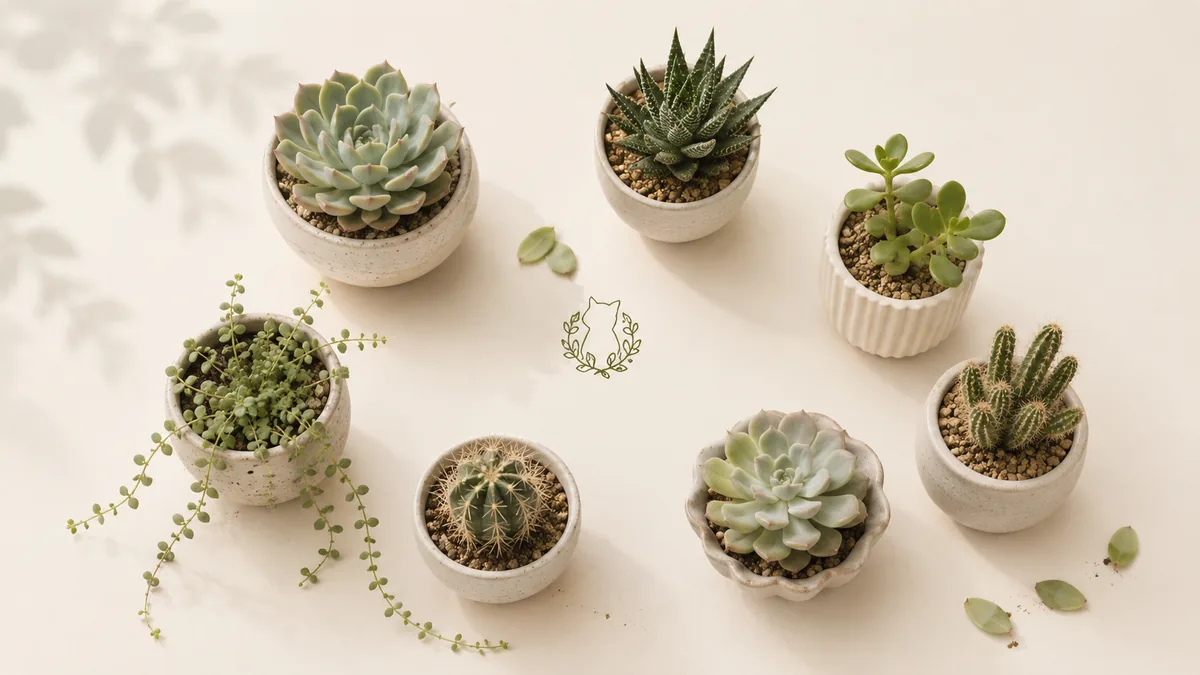
Succulents and Cactus Plants: Are They Safe for Cats?
Most succulents and cacti are relatively safe around cats, but aloe and kalanchoe are toxic exceptions. Here is what to check for each type before you buy.
Low-maintenance and undeniably cute, succulents and cacti are especially popular with people just getting into houseplants. If you have a cat, you have probably heard the reassuring line that "succulents are generally safe." In broad strokes that is true, but the word "succulent" covers such a wide range of plants that there are some exceptions. And separate from toxicity, there is the physical hazard of spines to think about too. This guide walks through what to check for each type.
Quick summary
- Most succulents and cacti are considered relatively safe.
- There are toxic exceptions like aloe and kalanchoe, so check each type individually.
- Apart from toxicity, spines and sharp leaves are a physical hazard.
- Manage the potting soil (leaf mold, fertilizer) so your cat cannot dig into or eat it.
- Before bringing a plant home, search its name on flower cat to confirm whether it is toxic.
"Succulent" is not a single plant
"Succulent" is a broad term for any plant that stores water in its leaves or stems. Beyond the ones we usually picture, like echeveria, haworthia, and sedum, the label also groups together plants that are botanically quite distant from one another. That is why "succulents are safe" cannot be applied to every succulent across the board. Echeveria and haworthia types are classified as non-toxic to cats (though any plant, eaten in large amounts, can cause mild stomach upset). On the other hand, some plants classified as succulents or that simply look like succulents do warrant caution, so it is better to identify the exact type than to relax just because you see the word "succulent."
Succulent types that need caution
A classic example of a plant whose succulent appearance is deceiving is aloe. Aloe is grown much like a succulent, but it is widely known to be toxic if a cat eats it. Its skin-care reputation might make it seem harmless, but that does not extend to cats. Flowering succulent types like kalanchoe are also toxic to cats. Ingestion can cause vomiting and diarrhea, and it contains compounds (bufadienolides) that can, in rare cases, disrupt the heart's rhythm, which is why it ranks alongside aloe as a succulent to watch out for. When you bring home an unfamiliar succulent in particular, it is worth confirming the exact species name and then searching separately for its toxicity.
Cactus plants: spines are often the bigger problem than toxicity
Cacti are not known for having many species that are dangerous through toxicity alone. The more realistic danger with cacti is the spines. If a curious cat bats at one with a paw or investigates it with its mouth and gets pricked, it can injure its paw pads, the area around its mouth, or its eyes. Tiny spines (glochids) are hard to see and hard to remove. So with cacti, the safer approach is not "it is non-toxic, so it is fine" but rather keeping them somewhere the cat physically cannot reach. Even types with few spines can have sharp leaf tips that cause injury, so placement still matters.
Beyond toxicity and spines: the pot and the soil
Even when the plant itself is safe, the pot environment can be a variable. Soil used for succulents and cacti may contain fertilizer or leaf mold, and a cat that digs into or eats the soil can get an upset stomach. Covering the soil with coarse sand (masato) or decorative stones to hide it, or using a heavier pot the cat cannot knock over, both help. Small succulent pots are light and easy to roll around, which makes them tempting toys for a cat. If one gets knocked down and breaks, soil and shards scatter everywhere, so keep them in a stable spot.
Frequently asked questions
Are all succulents safe? — Most are considered relatively safe, but there are exceptions like aloe. Do not relax on the word "succulent" alone. Identify the exact type and then search for it on flower cat. Do I only need to worry about spines with cacti? — Spines are generally the biggest risk, but cacti come in so many types that many have not been confirmed toxic or non-toxic. Some types may be toxic, so if only to prevent spine injuries, keep them out of your cat's reach. My cat took one bite of a succulent leaf. Will it be okay? — If it is a type known to be safe, it often does not lead to a serious problem, but if you are not sure of the type or you see symptoms like vomiting or drooling, contact your vet right away. My cat keeps messing with my succulent pot. — Move it to a high shelf or a spot the cat cannot climb to, and try a heavier pot. Covering the soil with stones can also reduce digging and eating.
Wrapping up
Succulents and cacti are considered a relatively easy choice for cat households, but "it is a succulent, so it is automatically safe" is not true. There are exceptions like aloe, and cacti carry the separate physical hazard of spines. When bringing home a new plant, remember the order: identify the exact type, search for its toxicity, and then plan its placement too. Searching a plant's name on flower cat lets you confirm its toxicity to cats right away.