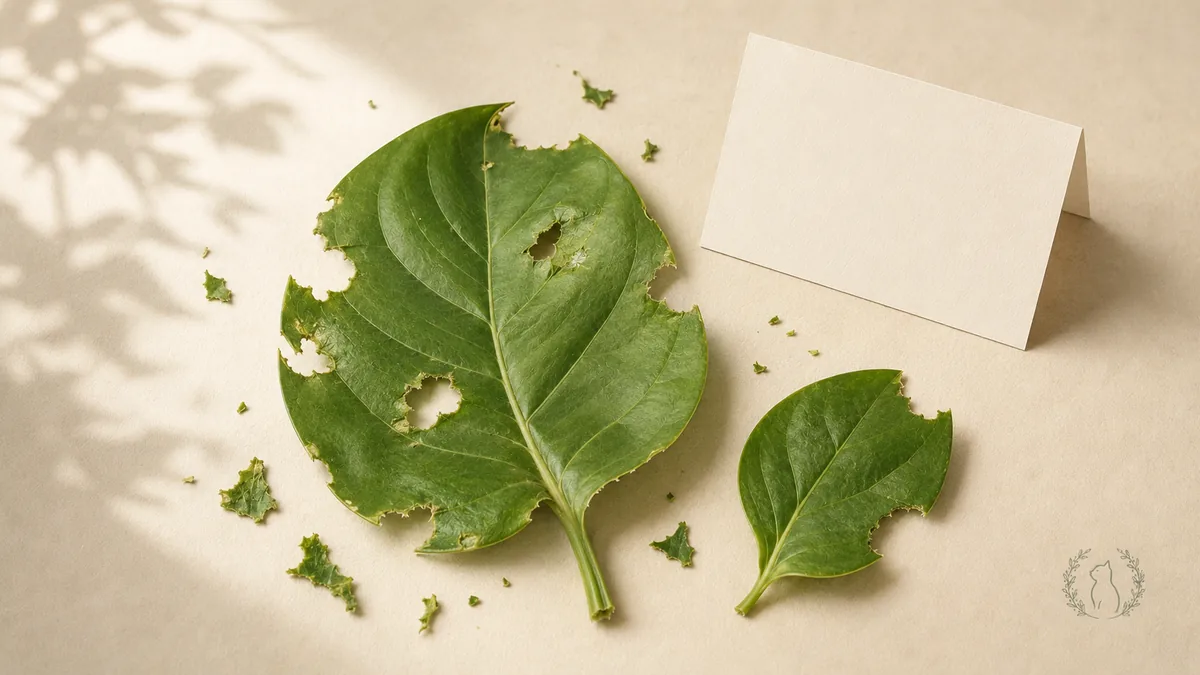
My Cat Ate a Plant — Symptom-by-Symptom Emergency Triage
Vet now or watch at home? Cross-reference toxicity grade and symptoms to decide what to do right now, plus the exact conditions for safe home monitoring.
The moment you catch your cat chewing on a houseplant leaf or nosing through a bouquet, the first question that hits you is simple: do I need to go to the vet, or can I wait and watch? The answer depends entirely on what your cat ate. Two situations that both look like "my cat ate a plant" can be worlds apart — a lily can be life-threatening even with no symptoms at all, while a single chewed-and-spat leaf may be fine to monitor at home. This guide answers exactly one question: do you need a vet right now, or is it safe to watch at home? We've cross-referenced toxicity grade and symptoms into a decision table so you can decide on the spot. That said, this is a general framework only — if you're in doubt, calling your vet first is always the safest move.
First — signs that mean vet now, regardless of grade
If you see even one of the following, get moving right now, no matter what your cat ate. You don't need the decision table.
- Labored breathing or open-mouth breathing
- Seizures, staggering, or a dazed, unresponsive state
- Unable to urinate
- A swollen mouth that prevents swallowing saliva
- Repeated vomiting that won't stop
Step 1 — Identify what was eaten
Your first job is to figure out exactly what your cat got into. Collect the leftover plant, any dropped leaves, the label on the bouquet, or the tag in the pot. If you don't know the name, take a photo — it helps your vet identify the species quickly. Once you have a name, search it in flower cat to check its toxicity grade. Grades fall into three broad tiers: the danger grade, where even a small amount is life-threatening, like lily; the caution grade, where the plant irritates the mouth and gut, like monstera or golden pothos; and the safe grade, where ingestion causes no serious problem. Once you know the grade, your next move becomes clear.
Step 2 — Observe which symptoms are present
If none of the emergency signs above are showing, look for the symptoms below. Which symptoms appeared, and when they started, become the basis for the next step.
- Vomiting or retching
- More drooling than usual, or repeatedly pawing at the mouth
- Lethargy, hiding, or reduced appetite
- Diarrhea
- Gums that look swollen, or signs of mouth pain Note when the symptoms began. Calcium oxalate plants trigger a reaction the instant they're chewed, while species that attack the kidneys — like lilies — may not show any signal until 6 to 12 hours later. The fact that "it's been a while since they ate it and symptoms are only starting now" is itself important information.
Step 3 — The decision table: grade × symptoms
Cross the grade and symptoms you identified in Steps 1 and 2, and your next action is set. If your cat ate a danger-grade plant:
- No symptoms → Go to the vet immediately
- Mild symptoms → Go to the vet immediately
- Emergency signs → Go to the vet immediately With a danger grade, symptoms do not change the call. All three cases are the same. If your cat ate a caution-grade plant:
- No symptoms → Monitor at home
- Mild symptoms → Monitor for 6 to 12 hours, then decide
- Emergency signs → Go to the vet immediately If your cat ate a safe-grade plant:
- No symptoms → No action needed
- Mild symptoms → Monitor at home (even safe plants can cause vomiting if overeaten)
- Emergency signs → Go to the vet immediately (the cause may be something other than the plant) If you don't know the grade — treat it as a danger grade until you can confirm otherwise. "Waiting and watching" while you're unsure is the most dangerous choice of all.
Danger grade — go to the vet even with no symptoms
Plants classified as danger grade, like lily and daylily, are the most frightening case. A single petal or one grain of pollen from a lily can lead to acute kidney failure within 24 hours, and a cat can look perfectly fine early on before suddenly crashing. That's exactly why "no symptoms, so it's probably fine" is the most dangerous judgment you can make. If there's any indication your cat came into contact with a danger-grade plant, call your vet and head in immediately, symptoms or not. We've laid out the step-by-step response in What to do when your cat eats a lily.
Caution grade — judge by amount and symptoms
Caution-grade plants like dieffenbachia, monstera, and golden pothos mostly work through calcium oxalate crystals that irritate the mouth and tongue. Chewing brings on immediate stinging and drooling, but if your cat only chewed once or twice and spat it out, rinsing the mouth with clean water and monitoring is usually enough. However, if symptoms persist beyond 6 to 12 hours, if vomiting repeats, or if mouth swelling prevents your cat from swallowing saliva, call your vet. For plants that concentrate toxins in the bulb — like daffodil and tulip — if there's any sign your cat chewed the bulb, it's safer to head in quickly even at the caution grade.
When it's okay to watch at home
Not every ingestion is an emergency. If all of the following conditions are met, monitoring at home is reasonable.
- The plant is confirmed to be safe or caution grade (does not apply if the grade is unknown)
- It was chewed and spat out, with no more than a leaf fragment or two swallowed
- Not a single one of the "vet now" signs above is present
- There's no indication the cat chewed a bulb
In that case, rinse the mouth with lukewarm water, leave water out so your cat can drink, and watch closely for 6 to 12 hours. If a new symptom appears during monitoring, or an existing one worsens, return to the decision table at that moment. One thing to add: "watching" does not mean forgetting. Write down when symptoms started and how they change. If you do end up at the vet, this record will make a big difference in how fast your cat can be treated.
If you've decided to go to the vet
Bring the actual plant or a photo, the time and amount ingested, and your symptom notes — and call ahead before you leave so the clinic knows the situation. We've laid out what to bring and in what order in the pre-vet poisoning checklist. Do not try to force vomiting at home, and do not use folk remedies like salt water or hydrogen peroxide. For cats, these can be dangerous rather than helpful.
Wrapping up
The two axes of the decision are grade and symptoms. Danger grade: go immediately, regardless of symptoms. Caution grade: judge by amount and symptoms. Safe grade: monitor. And when the axes wobble — when you don't know what was eaten — don't guess; call your vet first. An unknown situation leans, by itself, toward "go to the vet now."