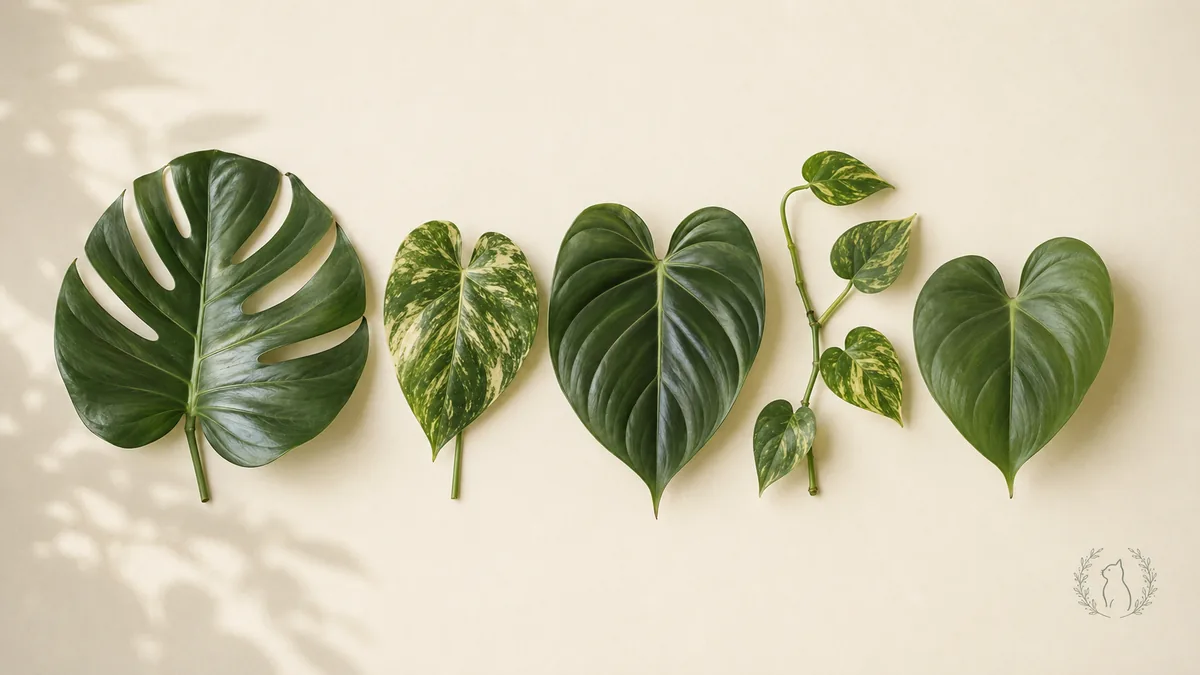
Monstera, Pothos & Philodendron: The Complete Guide to Calcium Oxalate Houseplants and Cats
The three most popular houseplants share calcium oxalate crystals. Learn why they irritate a cat's mouth, what symptoms to watch for, how to respond, and safe placement.
If you had to name the most popular houseplants in homes today, monstera, pothos, and philodendron would top the list. They are easy to grow and look striking, which is why they turn up in nearly every interior photo on social media. But if you share your home with a cat, there is one trait these three plants have in common that you should know about: calcium oxalate crystals. This guide explains why these three houseplant heavyweights irritate cats in the same way, what symptoms appear, how to respond, and where to place them safely, all based on flower cat data. Here is the bottom line up front: these plants are not a danger grade, they are a caution grade. They will not threaten your cat's life the way lilies can, but they clearly cause unpleasant symptoms, so placement matters.
What are calcium oxalate crystals?
Calcium oxalate is a microscopic, needle-shaped crystal held inside the leaf and stem tissue of these plants. It is a kind of defense mechanism the plant developed to protect itself from herbivores. Normally the crystals stay locked inside the tissue, but the moment a cat chews a leaf they burst out and physically pierce the soft lining of the mouth and tongue. That is why the irritation from these plants is less a chemical poisoning and more an immediate, physical pain. Monstera, pothos, and heartleaf philodendron all carry these crystals throughout their leaves and stems.
Why it irritates the mouth: symptoms that appear the instant a cat chews
The defining feature of calcium oxalate plants is that symptoms appear the instant a cat chews. Based on flower cat data, the symptoms these plants commonly produce when eaten are as follows.
- Oral irritation and burning
- Drooling more than usual
- Vomiting
- Difficulty swallowing and repeated pawing at the mouth
Fortunately, because the irritation is immediate and unpleasant, most cats chew once or twice and spit it right back out. As a result, large ingestions are rare, and symptoms usually settle down on their own.
Differences by grade: same compound, different intensity
All three plants share calcium oxalate crystals, but the intensity of the irritation varies slightly by species. Related plants in the same family, such as cordatum philodendron, lacy tree philodendron, and arrowhead vine, act in exactly the same way. Even within the same calcium oxalate family, dieffenbachia and caladium tend to cause stronger irritation, and caladium can even bring on a severe burning sensation. This more potent group is covered separately in Dieffenbachia, Aglaonema & Caladium: The Strong-Irritant Houseplants.
What to do if your cat chews one
If there are signs your cat has chewed a calcium oxalate houseplant, respond in this order.
- First, check for any leaf fragments left in the mouth and rinse the mouth with clean water.
- Offer plenty of fresh water to help ease the irritation inside the mouth.
- Make a note of how severe the drooling, vomiting, and other symptoms are, and when they started.
- Most cases settle within an hour or two, but if symptoms persist beyond 6 to 12 hours, or if breathing becomes labored and swelling in the mouth prevents your cat from swallowing saliva, contact your veterinarian immediately.
For the overall emergency decision flow, see My Cat Ate a Plant: Symptom-by-Symptom Emergency Triage.
How to place them safely
You do not have to give these plants up entirely, but the key is creating an environment your cat cannot reach. Many of these varieties have broad leaves that spread low and wide, so keeping them in floor pots makes them easy for a cat to chew. Place them on high shelves or in a separate room, somewhere kept apart from your cat's usual routes. Trailing vine types are especially tricky, because once the stems droop downward they eventually come within reach, so be particularly careful with placement. If your cat is very drawn to plants, another good approach is to set out cat grass as a safe alternative to chew on and redirect their interest.
Final thoughts
Monstera, pothos, and philodendron irritate cats in a similar way because of the same calcium oxalate crystals, but they are not a fatal danger the way lilies are. Neither excessive fear nor complacency is the right answer. The correct response is to place them out of reach in line with their caution grade, and if there are signs of chewing, to rinse the mouth and monitor how things progress.