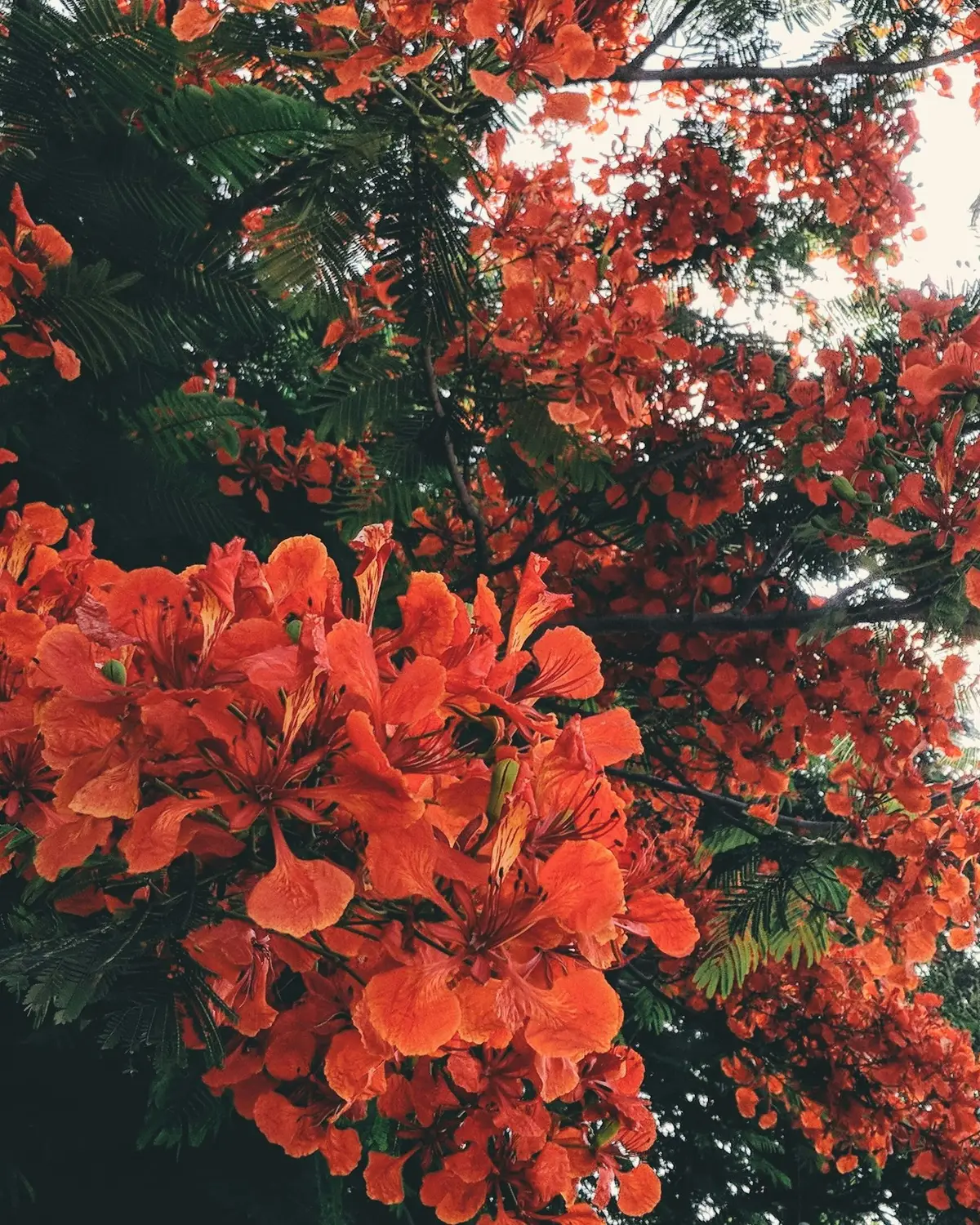
It isn't on the ASPCA list, so we can't call it safe. What is known so far is explained below.
Royal Poinciana
Delonix regia · Fabaceae
How it looks
A legume tree whose broad, umbrella-like crown is covered outright in large scarlet flowers. Each bloom has five petals, one of which is streaked with white or yellow. The leaves are bipinnate — feathery and twice-divided, like a silk tree's — so the shade they cast is soft, and a mature tree reaches 10–15 m. It drops its leaves where there is a dry season or a cool winter, but stays nearly evergreen in warm climates. Native to Madagascar, it is planted widely as a street and garden tree across the tropics and subtropics.
No toxicity data available
Royal Poinciana is not listed in the ASPCA's toxic plants list for cats, and NC State Extension has no toxicity data for it either. With no confirmed evidence either way, we cannot call it safe — exercise caution if your cat has access to it.
Guide for parents
Royal Poinciana has no official toxicity data, so it is hard to say for certain whether it is safe.
You are unlikely to meet it at a flower shop — most people encounter it as a street tree in the tropics. The seeds are another matter: after flowering it sets flat, woody pods up to 60 cm long, and those travel home as souvenirs or seed stock. A pod is exactly the size and sound a cat wants to bat around and gnaw, so keep any you bring back out of reach.
Mind the name overlap. "Poinciana" is not one plant: it is also used for Caesalpinia gilliesii (PLANT 143) and Caesalpinia pulcherrima (Barbados Pride, PLANT 181), both of which the ASPCA does list as toxic to cats. Check the botanical name rather than the label.
If ingestion is suspected, or you see vomiting, diarrhea, or drooling, contact your vet.
Details
- Scientific name
- Delonix regia
- Common name
- Royal Poinciana
- Family
- Fabaceae
- Source
- No confirmed source for cats — not listed by ASPCA
Also known as
Related plants
Same plant family· Fabaceae

Other plants with no confirmed rating
Related guides

Top 10 Flowers Dangerous to Cats — The Ones You See at Florists
Ten flowers you'll commonly find at florists and grocery stores that are toxic to cats. Check before you receive them, and before you bring them home.
Got a Bouquet? What to Do If You Have a Cat
A bouquet is a lovely surprise — but if you live with a cat, there are a few things to take care of right away. From checking what's in the arrangement to choosing the right vase, here's what actually helps, in order.
Why Cats Chew Plants, and How to Stop It
A cat chewing and tearing at plants isn't just mischief — there's an instinct behind it. Once you understand why, the ways to stop it follow naturally.